

Resources
-
A few ways to begin
Not everything worth having has a price, and not everything with a price is out of reach. Below you’ll find the things we make to help you start designing a clearer week — most of them free, none of them complicated. Read them, use them, keep them. They’re the simplest way to see how we think. Take what’s useful and leave the rest.
-
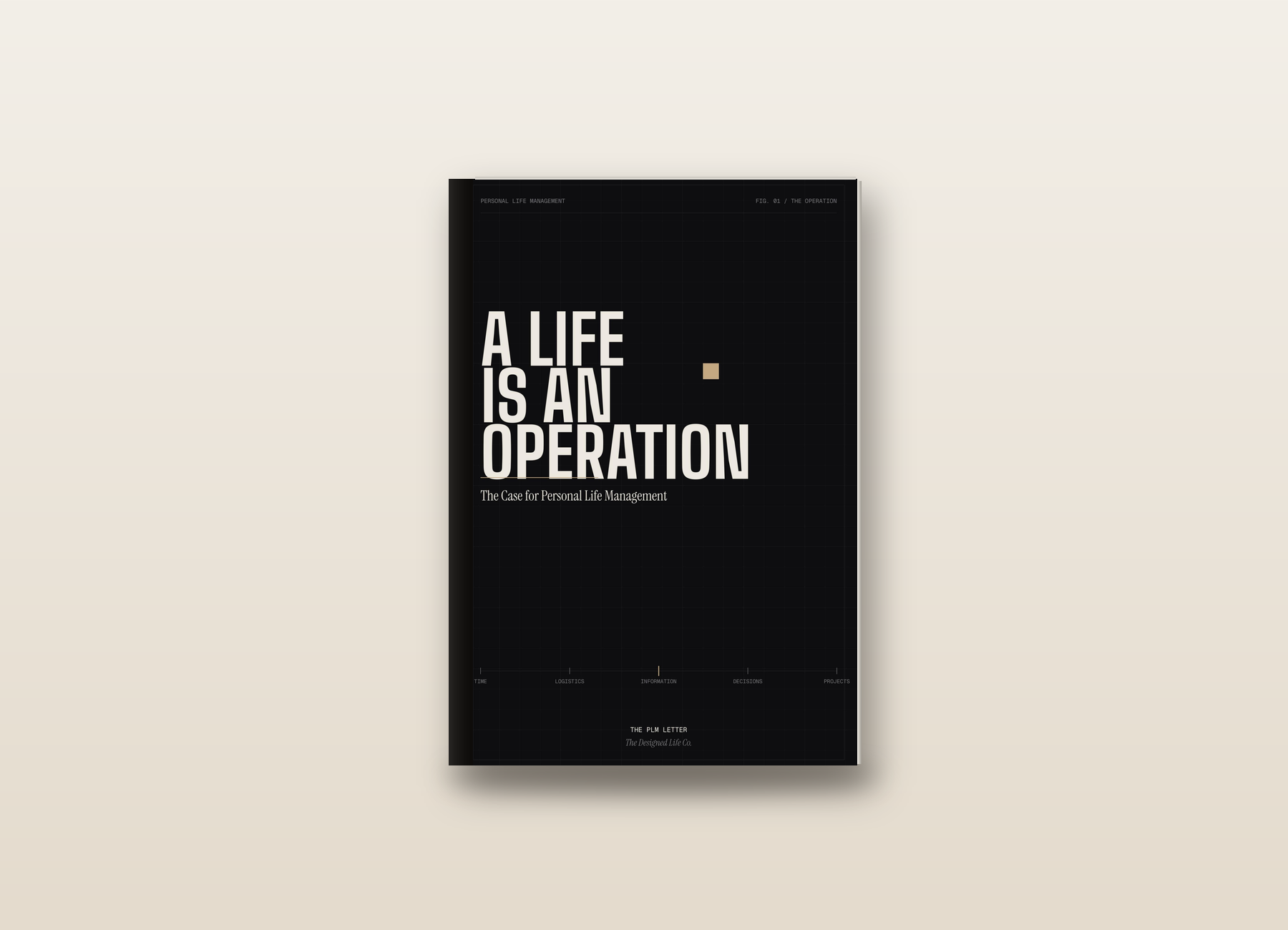
A Life As An Operation
Every company you’ve worked for had systems. Someone designed how work moved, how decisions were made, how information found the people who needed it. Your life has none of that — and no one ever said it should.
A Life Is an Operation is the founding argument of this company. It makes a simple claim with uncomfortable implications: you run a demanding operation every day of your adult life — a schedule, a logistics function, an information system, a stream of decisions, a portfolio of projects — and you were never taught to run it. No discipline was ever built to teach you.
The book names the two hidden gaps that quietly undo capable people, maps the five domains and eight dimensions of a life run well, and argues — with evidence — that managing a life is not a personal talent some are born with, but a field that can be defined, taught, and practiced.
It is the case for a discipline that didn’t exist until someone wrote it down. Everything this company makes — the planners, the app, the method, the work — begins here.
-
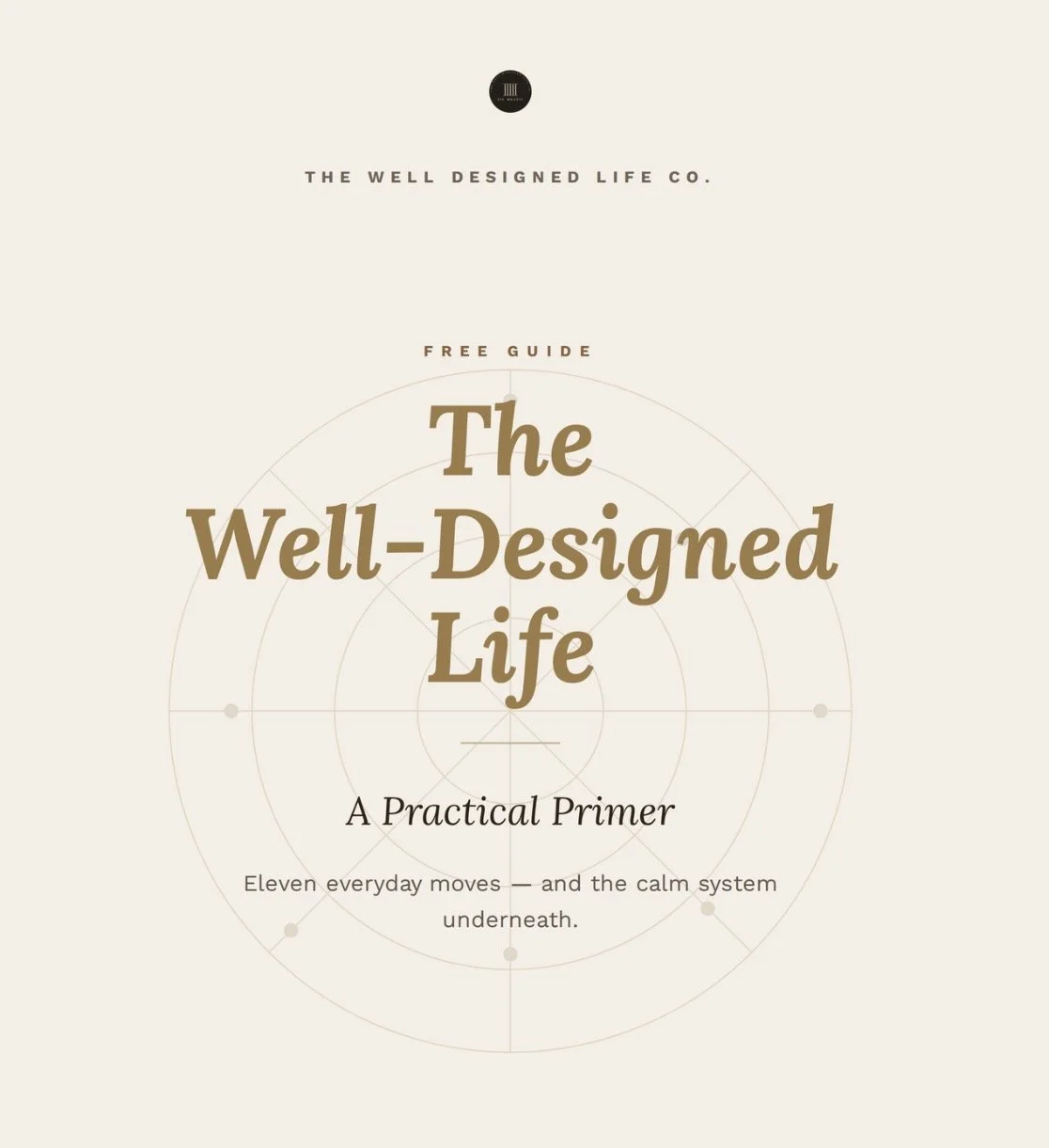
The Well Designed Life Primer
A free primer on running your life on purpose less about motivation, more about a little structure you can actually keep.
Most "get it together" advice hands you a feeling and no next step. This is different. Inside are eleven everyday areas of a full life your mornings, your space, your money, your people, your focus and for each one, a small thing you can do today, with the quiet reason it works. You can read it in one sitting and start before your coffee's cold.
One small, do-it-today move for eleven areas of life
The "why" underneath each one, so it actually sticks
A calm way to see where your life stands, runs, and holds together
-
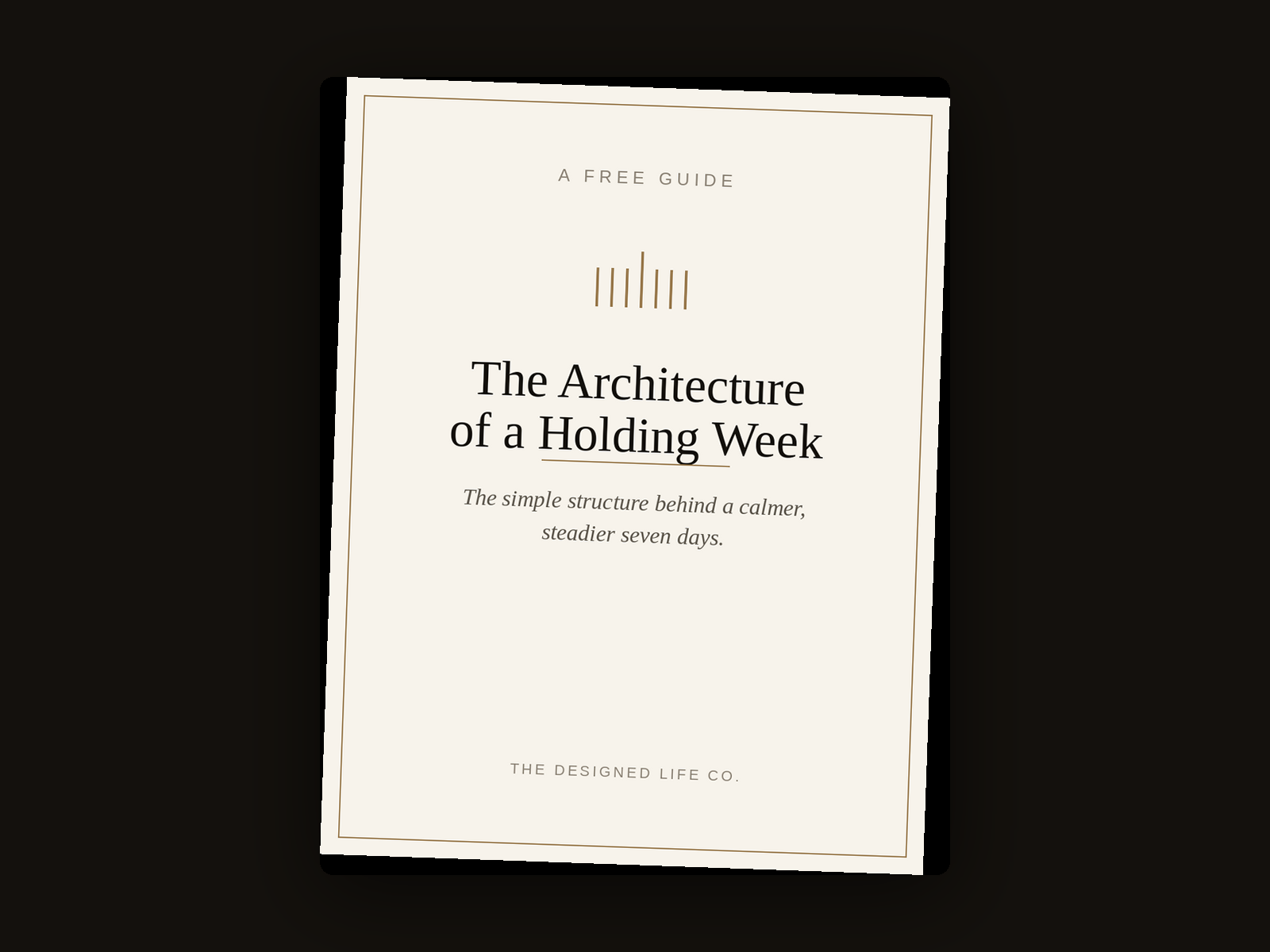
The Architecture of a Holding Week
Some weeks carry you. Most weeks, you carry them. This short guide is about the difference — and how to build more of the first kind.
Inside, you’ll find the simple structure behind a week that holds you up instead of wearing you down: how to anchor your days, protect the hours that matter, and stop the slow leak of time and attention that leaves you busy but never clear. It’s not a system to maintain or a method to master. It’s a handful of ideas you can use this Sunday and feel by Wednesday.
-
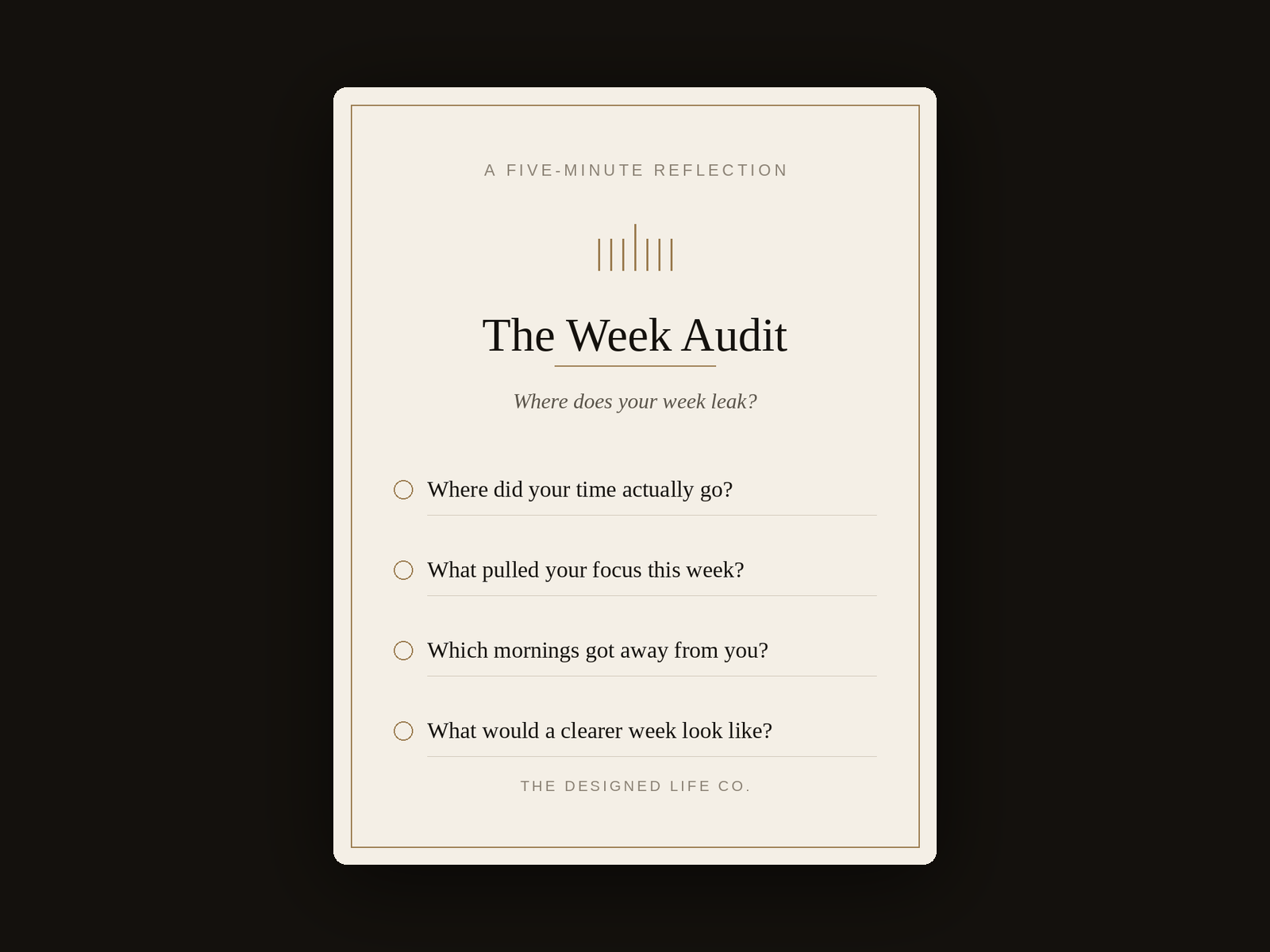
The Week Audit
Before you can design a better week, it helps to see clearly where this one went.
The Week Audit is a short, honest reflection — a few questions that show you where your week quietly leaks: the time that disappears, the focus that scatters, the mornings that get away from you. Five minutes with it, and you’ll have a clearer picture of what’s actually draining your week — and where a small change would do the most good. No scores to chase, no judgment. Just a clearer starting point.
-
One Designed Week Workbook
A designed week isn’t a fuller week — it’s a clearer one. This free one-pager gives you the whole practice in four small moves: look back on the week that ended, take stock of what mattered, design the week ahead around the two or three that matter, and close. Print it, or fill it on your tablet. Fifteen minutes, no streaks, no scores — just one week, authored on purpose.
-

The Operator’s Desk Newsletter
A weekly letter on running your personal life with the rigor a business runs on. Time, logistics, decisions, and the architecture underneath — the operational layer of a life, made visible and designable. For the person who runs everything well except their own week.
-
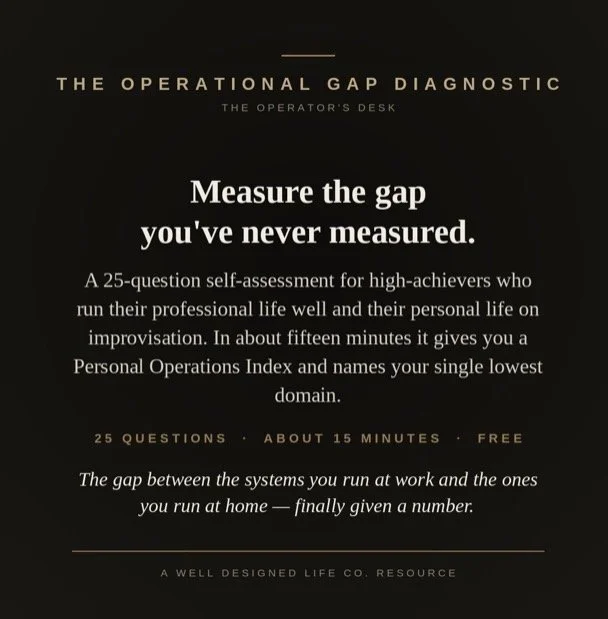
The Operational Gap Diagnostic
A 25-question self-assessment for high-achievers who run their professional life with rigor and their personal life on improvisation. In about fifteen minutes it measures the Operational Gap — the systematic mismatch between the systems you bring to work and the ones you bring home — and returns a Personal Operations Index, a severity band, and your single lowest domain. Not a willpower problem; a design problem, finally made visible.
MEASURES Whether your operational systems exist (the POI).
-
Follow The Operator's Desk
-
The Operating Week
You measured it — you have a Personal Operations Index, a severity band, and, more useful than either, a Dominant Gap: the single lowest domain on your profile. Most people file the result away and change nothing. This is the routing. Not a system overhaul — one designed week, aimed precisely at the domain your own result flagged lowest. For each of the five domains it gives you three things: the move (the single structural change), the week (how it sits across seven days), and the test (how you’ll know by Sunday whether it worked). Re-score next Sunday, then take the next-lowest domain. Five domains, five weeks, and the architecture starts to hold — not a transformation, a sequence of designed weeks.
A companion to the Operational Gap Diagnostic, from The Operator’s Desk.
-
The Balanced Edit Newsletter
A weekly letter on living well across all eight dimensions of a life — physical, emotional, intellectual, occupational, social, spiritual, environmental, and financial. Attention over optimization; a life designed rather than stumbled into. For the person ready to see the whole life, not just the busy parts.
-
The 8D Lifestyle Assessment
A reflective self-assessment across the eight dimensions of a flourishing life — physical, emotional, intellectual, social, occupational, financial, environmental, and spiritual — in the season you're actually in. Not a productivity test and not a checklist of shoulds: an honest, unhurried look that returns a score for each dimension and a Composite Lifestyle Index. The point is not to score well. The point is to see clearly.
MEASURES How the life is actually lived across eight dimensions (the 8D Composite).
-
The First Fifteen
You have your eight scores. The temptation is to launch a campaign at the lowest ones — a new regimen, a Sunday vow abandoned by Thursday. This gentle companion asks for something smaller and far more durable: not a plan, attention. Your two lowest dimensions aren’t the weakest parts of your life — they’re the parts that have been getting none of your attention, which is where a very little looking changes a great deal. So you choose your two lowest and give each a single honest fifteen minutes this week — a walk without a podcast, one account looked at, one person reached, one still moment. A low score isn’t a verdict; it’s the part of your life quietly asking to be seen. Fifteen minutes is small enough to survive and real enough to count.
A companion to the 8-Dimension Lifestyle Assessment, from The Balanced Edit.
-
Follow The Balanced Edit
-
The PLM Letter Newsletter
A weekly letter building the field of Personal Life Management one essay at a time — the integrating idea beneath systems, wellness, and the running of a life. The category this company is founded to address, written as it's being defined. For the person who suspects their life deserves a discipline of its own.
-
The PLM Integration Diagnostic
A 30-item assessment that measures the one thing the other two don't: integration — whether the architecture of your life actually serves the life you're living. It returns a Personal Integration Index and identifies the zone where your life is pulling apart. This is the instrument unique to Personal Life Management; no other field measures the gap between having systems and having a life those systems serve.
MEASURES Whether the systems serve the life (the PII).
-
The PLM Starter Kit
Why do so many capable people reach mid-career with professional lives of remarkable rigor — and personal lives running on improvisation? That mismatch has a name: the Operational Gap. This primer introduces Personal Life Management, the discipline built to close it — running your personal life with the same seriousness you bring to your work. In a single read it gives you the vocabulary, the founding idea, the master method (FLOW — Discover, Map, Design, Implement, Sustain), the five domains the discipline organizes around, and the two instruments that measure it (the POI and the PII). It’s enough to orient you — the on-ramp before the textbook. If the framework names something you’ve been trying to articulate, this is your invitation in.
A primer on the discipline, from The PLM Letter.
-
Follow the PLM Letter
-

Follow The Well Designed Life Co
Description goes here